Quick Answer
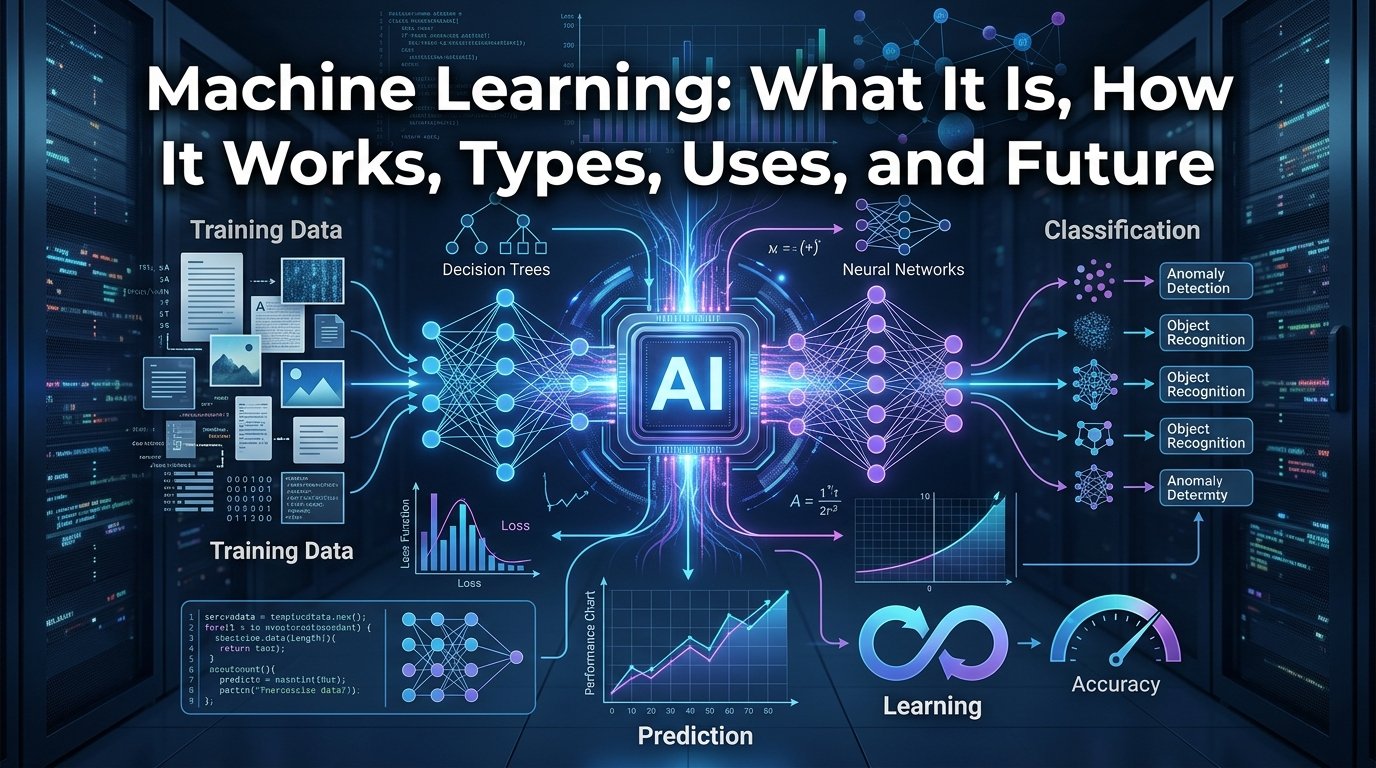
Machine Learning is a branch of artificial intelligence that allows computer systems to learn from data and improve their performance. Instead of programming every rule manually, developers train machine learning models with data so they can identify patterns and use those patterns to make predictions, classifications, or other outputs. NIST describes machine learning as the development and use of computer systems that adapt and learn from data with the goal of improving accuracy.
Introduction
Machine Learning has become an important part of modern technology. It powers many systems that people use every day, from recommendation systems and spam filters to image recognition, search technologies, fraud detection, and other intelligent applications.
The basic idea is simple. A machine learning system receives data, learns patterns from that data, and uses what it learned to produce useful results.
Machine Learning is closely connected to artificial intelligence, but the two terms do not mean exactly the same thing. AI is the broader field, while Machine Learning is one of the major approaches used to build AI systems. NIST describes AI broadly as machine based systems that can make predictions, recommendations, or decisions based on human defined objectives.
What Is Machine Learning?
Machine Learning is a method of developing computer systems that can learn from data and improve their performance.
In traditional programming, a developer usually provides explicit instructions for how a computer should perform a task. In Machine Learning, the system can learn patterns from examples and use those patterns to make predictions or decisions.
For example, imagine a system that needs to identify whether an email is spam. Instead of manually writing every possible spam rule, developers can train a machine learning model using examples of spam and legitimate emails. The model can learn patterns that help it classify new messages.
This does not mean the computer thinks like a human. It means the model uses mathematical and computational methods to learn relationships in data.
How Does Machine Learning Work?
A basic Machine Learning workflow involves several stages.
1. Collecting Data
The first step is gathering useful data related to the problem.
For example, a system designed to predict house prices might use information such as location, size, number of rooms, and previous sale prices.
2. Preparing the Data
Raw data often needs to be cleaned and organized before it can be used for training.
Missing values, duplicate records, incorrect information, and other data quality problems can affect the learning process.
3. Training the Model
During training, the machine learning algorithm processes data and learns patterns or relationships.
The model adjusts its internal parameters as it learns from the training examples.
4. Testing the Model
A model should be evaluated using data that was not used in the same way during training.
Testing helps determine whether the model can perform well on new data rather than simply memorizing its training examples.
5. Making Predictions
After training and evaluation, the model can receive new input and produce an output.
The output might be a category, prediction, recommendation, probability, or another result depending on the task.
Main Types of Machine Learning
Machine Learning includes several learning approaches. Three major categories are supervised learning, unsupervised learning, and reinforcement learning. NIST describes these approaches in its technical terminology and guidance.
Supervised Learning
Supervised learning uses data with known labels or target values. The model learns to predict the expected output from the input data.
For example, a model could learn from images that are labeled as either “cat” or “dog.” After training, it can attempt to classify a new image.
Supervised learning is commonly used for tasks such as classification and regression.
Classification
Classification predicts a category.
Examples include:
• Spam or not spam
• Fraud or not fraud
• Cat or dog
• Positive or negative sentiment
Regression
Regression predicts a numerical value.
Examples include:
• House price prediction
• Sales forecasting
• Temperature prediction
• Demand estimation
Unsupervised Learning
Unsupervised learning works with data that does not have predefined labels. The model looks for patterns or structures within the data. NIST describes clustering and grouping as examples of tasks that can be performed with unsupervised learning.
For example, a business might have customer data without predefined customer groups. An unsupervised learning system could identify groups of customers with similar characteristics.
Common applications include clustering and dimensionality reduction.
Reinforcement Learning
Reinforcement learning involves an agent interacting with an environment and receiving feedback through a reward function. The model learns behavior that helps optimize its rewards over time.
This approach can be useful for problems involving sequences of decisions.
Applications can include robotics, game playing, and autonomous control systems. NIST also identifies reinforcement learning as an important machine learning approach.
What Are Machine Learning Algorithms?
A Machine Learning algorithm is a computational method used to learn patterns from data or solve a particular learning problem.
Different algorithms work better for different types of tasks.
Some common examples include:
• Linear regression
• Logistic regression
• Decision trees
• Random forests
• Support vector machines
• K means clustering
• Neural networks
The choice of algorithm depends on factors such as the type of data, the problem being solved, the required performance, and how important interpretability is.
NIST material on Machine Learning discusses methods including logistic regression, decision trees, random forests, neural networks, clustering, and dimensionality reduction.
Machine Learning and Neural Networks
Neural networks are a type of machine learning model inspired by some aspects of how biological neural systems process information.
A neural network contains interconnected computational units arranged in layers. During training, the model adjusts parameters so that its output becomes more useful for the target task.
Neural networks have become important in areas such as image recognition and natural language processing.
More complex neural networks are often associated with Deep Learning.
Machine Learning vs Deep Learning
Machine Learning is the broader category. Deep Learning is a subset of Machine Learning that commonly uses neural networks with multiple layers.
| Feature | Machine Learning | Deep Learning |
|---|---|---|
| Scope | Broad field of learning methods | Subset of Machine Learning |
| Common models | Trees, regression, neural networks, clustering | Deep neural networks |
| Data needs | Can work with smaller datasets in some tasks | Often benefits from large datasets |
| Feature preparation | May require more human designed features | Can learn useful representations from data |
| Computing needs | Varies by model | Often higher for complex models |
This is a simplified comparison. The actual requirements depend on the specific model, dataset, and application.
Common Uses of Machine Learning
Machine Learning is used across many industries and applications.
Search and Recommendations
Machine learning can help systems understand patterns in user behavior and content. It can support search ranking, recommendations, and personalization.
Fraud Detection
Financial and other systems can use machine learning to identify unusual patterns that may require additional review.
Image Recognition
Machine learning models can analyze images and identify patterns or categories.
Applications can include object recognition, medical image analysis, quality inspection, and computer vision.
Natural Language Processing
Machine learning supports many language related applications, including text classification, translation, sentiment analysis, speech technologies, and modern language models.
Healthcare
Machine learning can support research, medical image analysis, prediction, and other healthcare related applications. Because healthcare decisions can be high stakes, systems require appropriate validation, oversight, and safeguards.
Cybersecurity
Machine learning can help identify unusual activity and support security monitoring. At the same time, machine learning systems themselves can face security threats. NIST notes that machine learning systems can be vulnerable to adversarial attacks, including evasion, poisoning, and privacy attacks.
Business Analytics
Companies can use machine learning to analyze data, forecast demand, identify patterns, and support decision making.
Benefits of Machine Learning
Machine Learning can provide several practical benefits.
Automation
Machine learning can automate certain data analysis and prediction tasks that would otherwise require repeated manual work.
Pattern Detection
Models can identify patterns in large datasets that may be difficult to analyze manually.
Personalization
Machine learning can help systems provide recommendations or experiences based on patterns in available data.
Prediction
Many machine learning applications focus on predicting future or unknown outcomes from available information.
Continuous Improvement
When systems are properly designed and retrained with appropriate data, their performance can be improved over time.
However, improvement is not automatic in every system. Data quality, model design, evaluation, and monitoring all matter.
Limitations of Machine Learning
Machine Learning is powerful, but it has important limitations.
Data Quality
A model depends heavily on the quality and relevance of its data. Poor quality data can produce poor results.
Bias
If training data contains problematic patterns or imbalances, a model can reproduce or amplify them.
Overfitting
A model can perform very well on training data but perform poorly on new data. This is known as overfitting.
Explainability
Some complex models can be difficult for people to interpret. This can create challenges when users need to understand why a system produced a particular result.
NIST notes that model complexity can affect interpretability and that transparency can be important when accountability is required.
Security Risks
Machine learning systems can be targeted by adversarial attacks. NIST’s 2025 adversarial machine learning taxonomy covers attacks and mitigations across multiple learning approaches.
Machine Learning vs Artificial Intelligence
Machine Learning and Artificial Intelligence are closely connected, but they are not identical.
| Feature | Artificial Intelligence | Machine Learning |
|---|---|---|
| Meaning | Broad field of intelligent computer systems | Approach that learns from data |
| Scope | Includes many techniques | One major area within AI |
| Main idea | Perform tasks involving intelligence | Learn patterns from data |
| Examples | Reasoning, planning, learning, perception | Classification, prediction, clustering |
| Relationship | Broader category | Part of AI |
A simple way to remember it is:
Artificial Intelligence is the broader field. Machine Learning is one important way to build AI systems.
Machine Learning and Generative AI
Generative AI and Machine Learning are also closely related.
Generative AI uses machine learning models to generate new content. Modern generative systems can produce text, images, audio, video, code, and other content.
This means Machine Learning is an important foundation for many modern generative AI systems.
However, not every machine learning model is a generative AI model. Many machine learning systems are designed for classification, prediction, detection, ranking, or other tasks.
How to Learn Machine Learning
If you are new to Machine Learning, start with the fundamentals.
First, learn basic programming concepts. Python is commonly used in machine learning education and development.
Next, understand basic mathematics such as statistics, probability, and algebra.
Then learn the main machine learning concepts:
• Training data
• Testing data
• Features
• Labels
• Models
• Algorithms
• Classification
• Regression
• Clustering
• Model evaluation
After learning the fundamentals, practice with small datasets and simple projects.
You do not need to start with the most complicated neural network. Understanding basic concepts first can make advanced topics much easier.
The Future of Machine Learning
Machine Learning continues to develop as researchers and engineers improve algorithms, data processing, model architectures, evaluation methods, and computing systems.
Machine learning is also becoming increasingly connected with other areas of technology, including generative AI, robotics, computer vision, natural language processing, cybersecurity, and automation.
At the same time, responsible development remains important. NIST emphasizes the need to consider security, robustness, privacy, and other risks when developing and deploying machine learning systems.
The future of Machine Learning will depend not only on creating more capable models, but also on making systems reliable, secure, understandable, and appropriate for their intended applications.
Conclusion
Machine Learning is a major part of modern artificial intelligence that allows computer systems to learn patterns from data and use those patterns to produce useful outputs.
Its main approaches include supervised learning, unsupervised learning, and reinforcement learning. These methods support applications ranging from recommendation systems and image recognition to fraud detection, cybersecurity, natural language processing, and business analytics.
Machine Learning also has limitations. Data quality, bias, overfitting, interpretability, and security can affect how well a system performs.
As AI continues to develop, Machine Learning will remain an important foundation for many technologies. Understanding its basic concepts can help anyone interested in artificial intelligence, data science, software development, or the future of technology.
FAQs
What is Machine Learning?
Machine Learning is an approach in which computer systems learn from data and use what they learn to improve their performance.
How does Machine Learning work?
A machine learning system is trained using data. The model learns patterns from that data and can then use those patterns to make predictions, classifications, or other outputs.
What are the three main types of Machine Learning?
The three commonly discussed major approaches are supervised learning, unsupervised learning, and reinforcement learning.
What is supervised learning?
Supervised learning is a type of machine learning in which a model learns from data with known labels or output values and uses that information to make predictions.
What is unsupervised learning?
Unsupervised learning uses unlabeled data to identify patterns, structures, or groups within the data.
What is reinforcement learning?
Reinforcement learning trains a model through interaction with an environment and feedback based on a reward function.
What is the difference between AI and Machine Learning?
Artificial Intelligence is the broader field, while Machine Learning is one major approach used to create AI systems.
Is Machine Learning the same as Deep Learning?
No. Deep Learning is a subset of Machine Learning that commonly uses neural networks with multiple layers.
What are common uses of Machine Learning?
Machine Learning is used in areas such as recommendations, search, fraud detection, image recognition, natural language processing, cybersecurity, business analytics, and many other applications.