Quick Answer
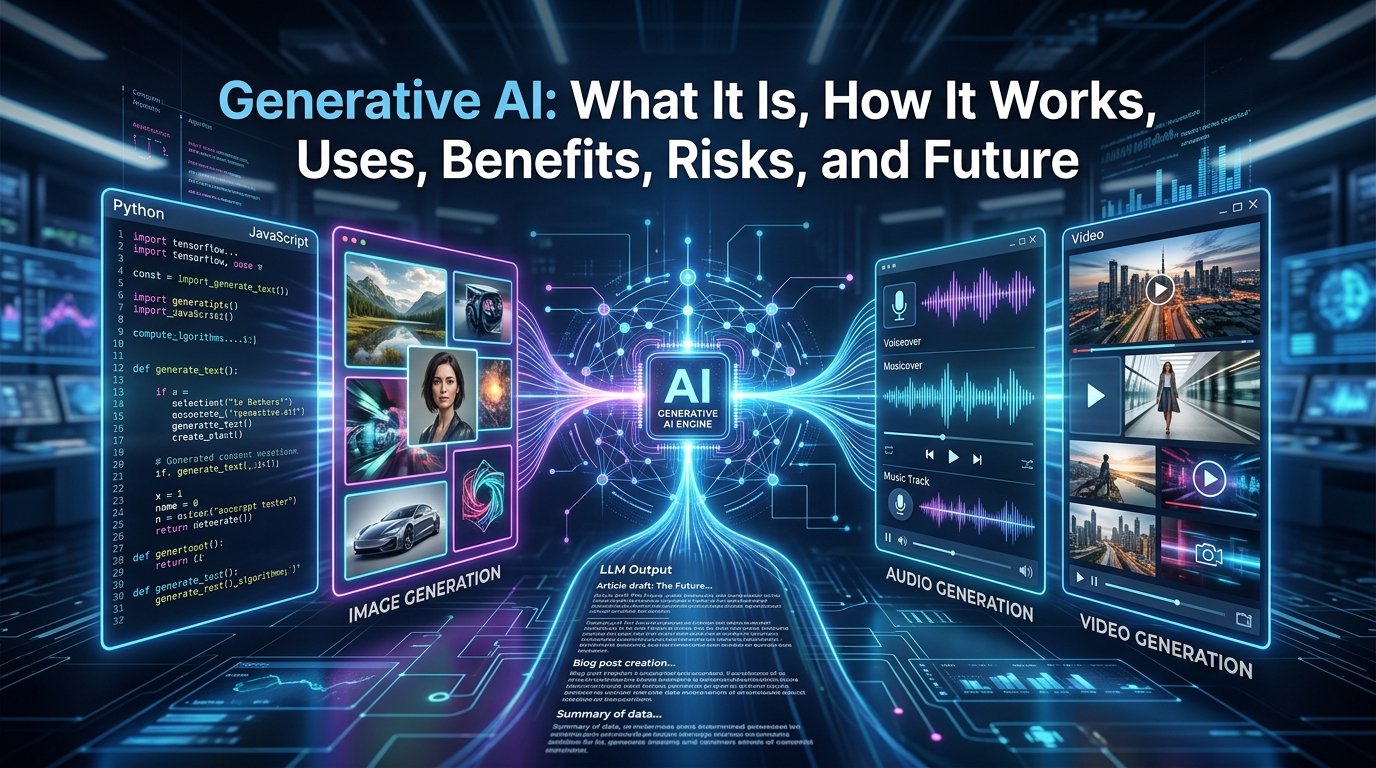
Generative AI is a type of artificial intelligence that can create new digital content from patterns learned from data. It can generate text, images, video, audio, code, and other forms of digital content. Unlike AI systems designed mainly to classify information or make predictions, generative AI focuses on producing new outputs based on a user’s instructions or other input. NIST defines generative AI as a class of AI models that can generate synthetic content such as images, videos, audio, text, and other digital content.
Introduction
Generative AI has become one of the most important areas of modern artificial intelligence. People can use generative AI to write and summarize text, create images, generate computer code, produce audio, assist with research, and support many other digital tasks.
The technology is useful because it can transform a simple instruction into a detailed output. However, generated content still needs human review. AI systems can produce incorrect information, misleading content, biased outputs, or material that creates privacy, security, copyright, and other risks. NIST has created a dedicated Generative AI profile within its AI Risk Management Framework to help organizations identify and manage these risks.
What Is Generative AI?
Generative AI refers to AI models designed to generate new content from patterns learned during training. The generated material can include text, images, audio, video, code, and other digital content.
For example, a user could provide a prompt asking an AI system to explain a scientific topic in simple language. A generative AI model can process the instruction and produce a new response.
The word “generative” is important because the system does not simply retrieve one fixed answer from a database. It generates an output based on patterns and relationships learned from its training data and the information provided in the interaction.
Generative AI is part of the broader field of artificial intelligence. AI includes systems that can perform tasks involving perception, learning, reasoning, communication, prediction, decision making, and other capabilities.
How Does Generative AI Work?
Generative AI systems use machine learning models trained on large amounts of data. During training, a model learns patterns and relationships within that data.
When a user provides an instruction, the model processes the input and generates an output based on what it learned.
For text generation, transformer based architectures are particularly important. NIST describes GPT models as a family of machine learning models based on the transformer architecture and trained through self supervised learning on large datasets of unlabeled text.
A simplified process looks like this:
- Data is collected and prepared for training.
- A machine learning model learns patterns from the data.
- The trained model receives an instruction or input.
- The model processes the input.
- The model generates an output.
- The user reviews and uses the result.
Modern generative AI systems can be much more complex than this simplified explanation. Different models use different architectures, training methods, data, and techniques.
Major Types of Generative AI
Generative AI is not limited to text. It can work across multiple forms of digital content.
Text Generation
Text generation systems can create articles, summaries, explanations, emails, outlines, stories, and other written material.
Large language models are an important part of modern text based generative AI. They can process natural language prompts and generate responses based on learned patterns.
Image Generation
Image generation systems can create new images from text descriptions or other inputs.
For example, a user might describe a futuristic city, a product concept, or an illustrated scene, and an image generation system can create an image based on that description.
Audio Generation
Generative AI can also produce or transform audio. Depending on the system, applications can include speech generation, sound creation, music related tasks, and other audio workflows.
Video Generation
Video generation is another area of generative AI research and development. Systems can generate or modify video content based on text, images, or other inputs.
NIST’s current GenAI evaluation work recognizes text, image, video, and audio as important areas for evaluating generative AI technology.
Code Generation
Generative AI can assist programmers by generating code, explaining existing code, suggesting solutions, and helping with software development tasks.
Generated code should still be reviewed and tested because an AI generated answer can contain errors or security problems.
Common Uses of Generative AI
Generative AI can support many types of work.
Education
Students and teachers can use generative AI to explain difficult concepts, create practice questions, summarize information, and support learning.
However, students should understand the material instead of simply submitting AI generated work without learning it.
Content Creation
Writers, marketers, designers, and creators can use generative AI to brainstorm ideas, create drafts, summarize information, and develop creative concepts.
Human editing remains important because generated content may contain factual or contextual problems.
Software Development
Developers can use generative AI for code suggestions, explanations, debugging assistance, documentation, and other programming tasks.
The output should be tested before it becomes part of a real software project.
Business
Businesses can use generative AI for drafting documents, summarizing information, customer support workflows, research assistance, and internal productivity tasks.
Organizations also need to consider privacy, security, accuracy, and governance when using these systems.
Research
Researchers can use generative AI to help organize information, summarize material, generate ideas, and support certain analytical workflows.
AI should support research rather than replace source verification.
Benefits of Generative AI
Generative AI can provide several practical benefits.
Faster Content Creation
AI can quickly generate a starting point for text, images, code, and other content. This can reduce the time required for some repetitive tasks.
Idea Generation
Generative AI can help users brainstorm topics, concepts, designs, questions, and possible approaches to a problem.
Personalized Explanations
A user can ask an AI system to explain the same topic at different levels of difficulty. This can make complicated subjects easier to understand.
Productivity Support
Generative AI can assist with tasks such as summarization, drafting, organization, coding, and information processing.
Creative Assistance
Creators can use generative AI to explore ideas and produce early concepts for different types of digital content.
Limitations and Risks of Generative AI
Generative AI also introduces important challenges.
Incorrect Information
A generative AI system can produce information that sounds convincing but is incorrect. Users should verify important factual claims against reliable sources.
Bias
AI models can reproduce or amplify biases present in their training data or other parts of the system.
Privacy
Users should be careful when entering personal, confidential, or sensitive information into AI systems.
Security
Generative AI can create new security challenges. Organizations need processes for evaluating how AI systems interact with software, data, users, and other systems.
Misleading Synthetic Content
AI generated content can make it harder to determine whether some digital material was created by a person or generated by an AI system. NIST’s GenAI evaluation work specifically examines questions related to the believability and distinguishability of generated content.
Copyright and Intellectual Property
Generated content can raise questions about ownership, training data, licensing, and the appropriate use of copyrighted material. The exact legal situation can vary by jurisdiction and use case, so important legal questions should be reviewed with qualified legal guidance.
NIST’s Generative AI risk profile identifies risks that can be new or increased when generative AI is used and provides suggested actions for organizations to manage those risks.
Generative AI vs Traditional AI
| Feature | Generative AI | Traditional AI |
|---|---|---|
| Main purpose | Creates new content | Often predicts, classifies, or makes decisions |
| Common outputs | Text, images, audio, video, code | Predictions, classifications, recommendations |
| User interaction | Often prompt based | Often task or data based |
| Example use | Generate an article or image | Detect spam or classify an image |
| Human review | Important | Important |
This comparison is simplified because AI systems can combine generative and non generative capabilities.
How to Use Generative AI Effectively
Getting useful results from generative AI depends heavily on the quality of the instructions and the review process.
Start with a clear goal. Instead of asking for something extremely broad, explain what you want the system to produce.
Include useful context. Tell the model the audience, format, length, topic, and important requirements.
Ask for a specific output format when necessary. For example, you can request a table, outline, checklist, explanation, or structured article.
Review the result carefully. Check facts, calculations, citations, code, names, dates, and other important details.
Use reliable sources for verification. Generative AI can help you understand information, but it should not automatically be treated as the final authority.
The Future of Generative AI
Generative AI continues to develop across text, image, audio, video, and other forms of digital content. NIST’s ongoing evaluation programs show that researchers are actively studying the capabilities and limitations of these systems.
Future development will likely involve improvements in model capabilities, multimodal systems, evaluation methods, reliability, security, and methods for managing AI related risks.
At the same time, responsible development will remain important. NIST’s Generative AI profile is specifically designed to help organizations govern, map, measure, and manage risks associated with generative AI.
The future of generative AI will therefore depend not only on what models can generate, but also on how people and organizations evaluate, control, and use those capabilities.
Conclusion
Generative AI is a major area of artificial intelligence that can create new text, images, audio, video, code, and other digital content. Its ability to transform natural language instructions into useful outputs makes it valuable across education, business, software development, research, and creative work.
FAQs
What is Generative AI?
Generative AI is a class of artificial intelligence models that generates new synthetic content such as text, images, audio, video, and other digital content from learned patterns and user inputs.
How does Generative AI work?
Generative AI models learn patterns from training data. When they receive an instruction or other input, they process it and generate an output based on what they learned.
What can Generative AI create?
Generative AI can create or assist with text, images, audio, video, computer code, and other forms of digital content.
Is Generative AI the same as artificial intelligence?
No. Generative AI is one area within the broader field of artificial intelligence. AI includes many systems designed for tasks such as prediction, classification, planning, learning, communication, and decision making.
What are the main benefits of Generative AI?
Common benefits include faster content creation, brainstorming assistance, personalized explanations, productivity support, and help with creative and technical tasks.
What are the risks of Generative AI?
Important risks can include incorrect information, bias, privacy concerns, security issues, and misleading synthetic content. NIST has developed a dedicated Generative AI risk profile to help organizations address these types of challenges.
Can Generative AI replace human judgment?
Generative AI can assist with many tasks, but human review remains important, particularly when accuracy, safety, privacy, security, or important decisions are involved.